
General framework
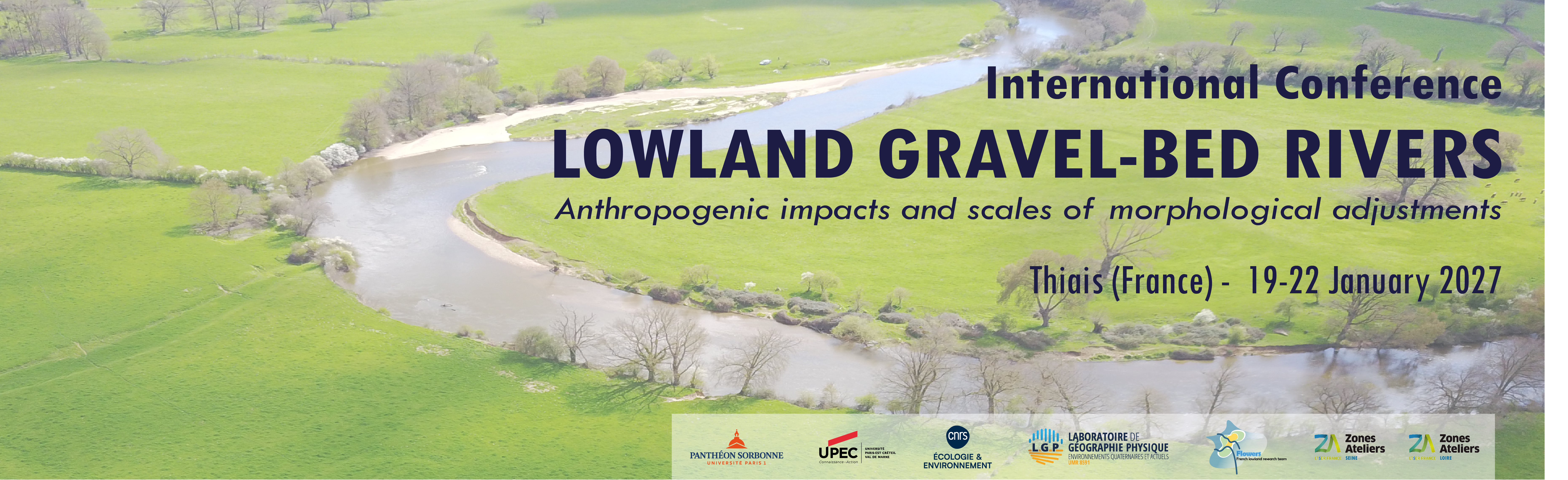
The dynamics of gravel-bed rivers have mainly been studied in mountainous and piedmont areas, in a context of relatively high energy and abundant coarse sediment supply. In contrast, lowland rivers have received less attention. Here we define low- to medium-energy gravel-bed rivers (with a bankfull specific stream power lower than 40-60 w m-2). We also consider the particularities of the spatial and time scales at which they adjust their morphology in response to the relative slowness of processes governing their functioning. Lowland gravel-bed rivers have undergone indirect and direct anthropic modifications which have greatly reduced their mobility (from the scale of particles to that of river courses) and simplified their morphology. This has threatened the essential ecosystem services they provide to societies to varying degrees.
Despite their reduced intrinsic energy and the coarse sediments they carry that make up their beds, these rivers possess a significant potential for (self-)restoration. However, we still have a significant lack of understanding regarding the spatial and temporal scales at which the various components of these river systems are capable of readjusting, which severely limits our ability to define and calibrate appropriate remediation solutions to the negative effects of current and past anthropogenic pressures. There is thus a marked knowledge gap regarding our understanding of the dynamics governing both the mobility of these rivers (from the scale of their courses to that of individual particles) and of the spatio-temporal variability of this mobility. The latter is controlled, on the one hand, by changes in morphogenic flows in a context of climate change, and, on the other hand, by the rivers’ access to inherited coarse alluvial material. This access is modulated by the influence of river engineering works (bank protection and weirs in particular).
Objectives
The aim of this conference is to gain a better understanding of 1) how the riverbeds of low- to medium-energy gravel-bed rivers have been shaped by a long history of direct anthropogenic influences (land uses and developments within the river channel and the adjacent floodplain) and indirect influences (control of water flow and changes in land use at the catchment scale), 2) how these rivers move in the absence of direct anthropogenic constraints and under the influence of which factors, 3) how this mobility controls the diversity of aquatic and riparian habitats, 4) how fluvial engineering works do or do not alter these relationships, 5) and finally, how these relationships have evolved and will evolve under the influence of climate change, from the beginning of the Quaternary period to the end of the 21st century.
Important information
Conference dates: 19–22 January 2027. Filed trip on 19 January. Sessions from 20 to 22 January. Dinner in Paris on 20 January
Venue: Campus of the Laboratory of Physical Geography, Thiais, France
Call for papers: 1 April 2026 to 30 June 2026
Registration: 1 June 2026 to 30 November 2026
Conference language: English
